Find out why PRP therapy is becoming popular for treating plantar fasciitis and Achilles tendon injuries to reduce foot pain.
Abstract
In this educational clinical post, we explore a paradigm-shifting approach to treating chronic heel pain and plantar fasciitis. Rather than focusing solely on the localized pain at the bottom of the foot, modern biomechanical analysis and regenerative medicine point to the Achilles tendon and gastrocnemius-soleus complex as the primary culprits in fascial micro-tearing. By utilizing advanced regenerative injections—such as Platelet-Rich Plasma (PRP) and prolotherapy—directed at the Achilles bifurcation and fascial attachments, clinicians can facilitate profound tissue healing. This article comprehensively breaks down the physiological underpinnings of tendinosis, the exact anatomical injection protocols utilized in our multidisciplinary practice, safety guidelines regarding vascular avoidance, and the integration of chiropractic rehabilitation to ensure long-term structural integrity.
The Multidisciplinary Foundation of Comprehensive Care
As a healthcare provider, my passion lies in uncovering the root causes of musculoskeletal dysfunction and providing treatments that genuinely restore function. I am Dr. Alex Jimenez, DC, APRN, FNP-BC, CFMP, IFMCP, ATN, CCST. Throughout my clinical journey, I have come to realize that the most effective patient outcomes are achieved through a collaborative, multidisciplinary approach. This philosophy is the cornerstone of our practice at Injury Medical Clinic PA, also known as Mission Plaza Injury Medical Clinic, located in El Paso, Texas.

I am incredibly privileged to work alongside Dr. Maria Guadalupe Cardenas, MD (Board Certified in Internal Medicine) (NPI #1164426749, Texas MD License #J2933). With over 40 years of invaluable experience as an internist, Dr. Cardenas serves as our Medical Director and Collaborative Physician. This integrative setup is a hallmark of elite injury care clinics. While I focus on chiropractic care, advanced functional medicine, personal injury rehabilitation, and biomechanical alignment, Dr. Cardenas provides critical medical oversight and internal medicine expertise. Together, we bridge the gap between traditional allopathic medicine and holistic, regenerative therapies. This powerful synergy ensures that every patient receives a comprehensive, medically sound, and meticulously tailored treatment plan that addresses both their physiological deficits and structural imbalances.
Today, July 19, 2026, I want to share the latest clinical insights and evidence-based methodologies regarding a condition that plagues millions: plantar fasciitis. By integrating chiropractic biomechanical correction with the advanced regenerative injection protocols overseen in our medical setup, we are redefining how this debilitating condition is treated.
Rethinking the Biomechanics of Plantar Fasciitis
For decades, the standard medical approach to heel pain has been to treat the plantar fascia directly. However, the latest findings from leading researchers, corroborated by our own clinical observations, suggest that the plantar fascia is often the victim, not the primary instigator, of the pain cycle.
The physiological underpinning of this concept relies on understanding the kinetic chain of the lower extremity. The gastrocnemius and soleus muscles merge to form the Achilles tendon, which inserts into the posterior aspect of the calcaneus (heel bone). The intricate fascial connections continue around the calcaneus and blend seamlessly into the plantar aponeurosis.
When a patient suffers from chronic plantar fasciitis, the root of the pathology frequently lies in chronic tendinosis of the Achilles tendon and the gastrocnemius complex. Let us examine the nocturnal physiological cycle of a patient suffering from this condition:
- The Sleep State: When a patient lies in bed at night, the foot naturally falls into a state of plantar flexion (pointing downward).
- Tissue Shortening: In this position, the calf muscles and the Achilles tendon remain in a shortened, contracted state for several hours.
- The Morning Trauma: Upon waking and stepping out of bed, the patient forcefully dorsiflexes the foot, placing full body weight onto the limb. Because the posterior chain (calf and Achilles) is chronically tight and inelastic due to underlying tendinosis, it cannot accommodate this sudden stretch.
- Micro-Tearing: The tensile force bypasses the shortened Achilles and is violently transferred to the plantar fascia, resulting in acute micro-tearing near its insertion at the medial calcaneal tubercle.
Cumulatively, over time, this repeated morning trauma leads to chronic inflammation, cellular degeneration, and debilitating pain with every step. Therefore, treating the plantar fascia directly is akin to treating the symptom while ignoring the disease. If we fix the tightness and degeneration in the posterior chain, the plantar fascia finally has the mechanical reprieve it needs to heal.
The Pitfalls of Traditional Plantar Injections
Historically, the standard of care involved injecting corticosteroids directly into the sole. While this can provide temporary anti-inflammatory relief, it carries profound risks. Corticosteroids inhibit collagen synthesis, which can lead to the catastrophic rupture of the fascial band.
Furthermore, direct injections into the heel pad often result in fat pad syndrome or fat pad atrophy. The adipose tissue under the calcaneus is highly specialized, compartmentalized fat designed for shock absorption. When you inject therapeutic agents—even regenerative ones like prolotherapy—directly into the plantar aspect of the heel, it can cause severe trauma to this delicate tissue. The fat pad degenerates, and unfortunately, that specialized shock-absorbing fat never regenerates. Attempts by orthopedic surgeons to surgically replace this fat or implant artificial substitutes have historically yielded poor clinical outcomes.
Additionally, inserting a needle into the highly innervated, thick dermal layers of the plantar surface is excruciatingly painful for the patient. It introduces a new mechanical trauma to an already vulnerable and hyper-inflamed tissue bed. I previously performed traditional prolotherapy directly into the fascia, but the resulting hyper-inflammation and iatrogenic needle trauma often caused a secondary, poking pain that deterred patient compliance.
A Paradigm Shift in Regenerative Injection Protocols
The breakthrough in our clinical approach was born from collaborative frustration with traditional methods. About eight years ago, during an informal brainstorming session with an esteemed colleague, Dr. Roman, an orthopedic surgeon and faculty member at the University of Nevada Medical School, we mapped out a new protocol. We realized we had to stop sticking needles into the bottom of people’s feet.
Instead, we formulated an evidence-based rationale for targeting the Achilles tendon bifurcation and the posterior fascial attachments. Dr. Roman initially utilized this protocol in an N-of-1 clinical trial, which yielded remarkable success and was subsequently published. Over the years, we have refined this technique, heavily relying on Platelet-Rich Plasma (PRP) and advanced prolotherapy solutions.
The Regenerative Injection Technique: A Clinical Walkthrough
Implementing this protocol requires a meticulous understanding of regional anatomy, precise tactile feedback, and strict adherence to safety guidelines. Here is a detailed breakdown of how we perform this life-changing procedure in our clinic.
Locating the Optimal Entry Point
The first step is properly positioning the patient and locating the precise anatomical landmarks.
- Patient Positioning: The patient is placed in a prone position. I instruct them to relax the leg completely. I often rest their foot against my own body or leg to maintain optimal control and to effortlessly manipulate the ankle joint.
- Palpation: I run my thumb superiorly along the Achilles tendon until I locate the anatomical bifurcation. In this area, the gastrocnemius aponeurosis begins to split and merge with the underlying soleus muscle fibers.
- Dynamic Assessment: By gently flexing the patient’s foot, the tendon becomes more prominent, allowing for exact pinpointing of the bifurcation. The tissue here will often present with a distinct “ropiness” or palpable thickening, indicating chronic tendinosis. This area of maximum tenderness and structural alteration is our primary target.
Precision Needle Angulation and Tissue Feedback
Once the entry point is identified and prepped, the injection mechanics must be flawless to ensure patient comfort and therapeutic efficacy. We typically utilize a 5 cc syringe filled with our biologic of choice.
- Initial Entry: The needle is introduced with the bevel pointed up to prevent tissue coring and to allow for a smoother glide through the fascial planes.
- Subcutaneous Penetration: We break the subcutaneous (sub-Q) barrier first, advancing the needle straight down about halfway. It is critical not to inject superficially, as pooling fluid in the sub-Q space offers no therapeutic benefit to the tendon and can cause significant localized swelling.
- The Pivot Technique: Once halfway in, the needle is carefully tipped or leaned, aligning its trajectory parallel with the fibers of the tendon.
- Tactile Confirmation: As the needle is advanced into the tendinous tissue, there is a distinct, palpable change in tissue resistance. The texture goes from the soft, yielding fat of the sub-Q layer to a denser, slightly “crunchy” or firm resistance. This tactile feedback confirms we are accurately situated within the peritenon and tendinous matrix.
- Delivery: Once positioning is confirmed, approximately 1 cc of the regenerative solution is gently deposited. The patient should experience minimal to no pain during the actual fluid delivery if the needle is correctly seated within the pathological tissue spaces rather than distending healthy nerve-rich sheaths.
Anatomical Attachments and Maximum Tenderness
After addressing the bifurcation, we turn our attention to the distal insertions. The Achilles tendon attaches to the posterior calcaneus, spreading its fibers both medially and laterally.
- Palpating the Fan: I trace the tendon inferiorly to where it fans out and ends at the bone.
- Identifying Pathology: I query the patient on their pain response, asking if the tenderness is more pronounced on the medial or lateral aspect. In most chronic cases, the medial aspect is significantly more tender due to the biomechanical stress of pronation during the gait cycle.
- Targeted Delivery: Approaching from an optimal angle, I advance the needle about halfway to the bone and deposit a precise 0.5 cc micro-dose of the biologic directly into the point of maximum tenderness on both the medial and lateral attachments.
Critical Safety Protocols: The Aspiration Mandate
When performing any regenerative injection, particularly around the ankle, vascular safety is paramount. The lower leg is highly vascularized, containing significant structures like the posterior tibial artery and the lesser saphenous vein.
- The Aspiration Rule: Before depressing the plunger to inject any solution—especially if it contains anesthetics like lidocaine—you must rigorously aspirate.
- Negative Pressure: By pulling back on the syringe plunger, we create negative pressure. If the needle tip is resting inside a blood vessel, the hub of the syringe will immediately fill with blood. This is known clinically as a flash.
- Managing Vascular Entry: If a flash occurs, the procedure is instantly paused. We are unequivocally in the wrong anatomical space. Injecting lidocaine or hyperosmolar dextrose intravascularly can lead to severe systemic complications, toxicity, or tissue necrosis. The protocol dictates withdrawing the needle, clearing the flash from the syringe, and re-evaluating the anatomical landmarks to find a safe, avascular injection site.
The Science of Biologics: PRP versus Prolotherapy
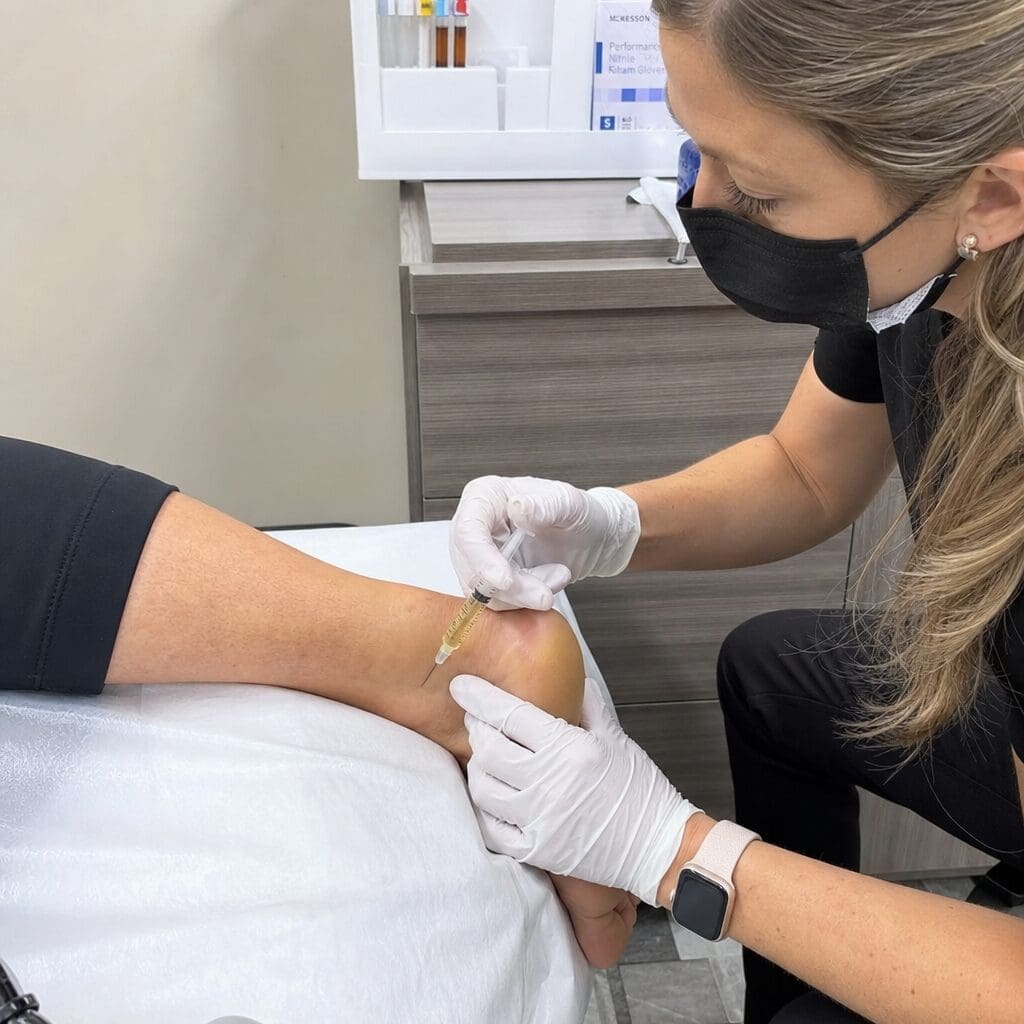
The success of this technique relies heavily on the specific biologic agent utilized. In our integrative practice, we primarily utilize two modalities: Platelet-Rich Plasma and Prolotherapy.
Platelet-Rich Plasma (PRP)
Platelet-Rich Plasma (PRP) is the gold standard for this protocol. PRP is an autologous treatment, meaning it is derived from the patient’s own blood. We centrifuge the whole blood to isolate and concentrate the platelets, which are densely packed with vital growth factors, including:
- Platelet-Derived Growth Factor (PDGF): Stimulates cellular replication and angiogenesis (the formation of new blood vessels).
- Transforming Growth Factor-Beta (TGF-β): Regulates the extracellular matrix and promotes collagen synthesis.
- Vascular Endothelial Growth Factor (VEGF): Highly potent in triggering blood vessel growth in avascular tissues like tendons.
When PRP is injected into the hypoxic, degenerated tissue of the Achilles tendinosis, it acts as a massive biological catalyst. It bypasses the chronic, stalled state of the tissue and immediately initiates the proliferation and remodeling phases of the healing cascade. PRP is incredibly efficient; patients typically see rapid and profound improvements.
Prolotherapy
Prolotherapy utilizes a hyperosmolar solution, most commonly concentrated dextrose. When injected into damaged tissue, the high osmotic gradient causes localized cellular lysis, artificially triggering a targeted inflammatory response.
- The Inflammatory Cascade: This localized, controlled inflammation tricks the body into recognizing the chronic injury as a new, acute injury. The immune system dispatches fibroblasts and macrophages to the area to begin laying down new, healthy Type I collagen.
- Clinical Considerations: While prolotherapy is highly effective, it operates via a different mechanism than PRP and is generally less efficient. Because it relies on hyper-inflammation to stimulate healing, it requires a longer treatment course. A typical prolotherapy regimen requires about six treatments to yield significant clinical turnaround—starting with weekly injections for four weeks, followed by bi-weekly treatments. However, when combined synergistically with PRP, the clinical outcomes are extraordinary.
Post-Procedural Care and Chiropractic Integration
The biological injection is only the first phase of healing. The tissue must be protected while it reorganizes, and the underlying biomechanical faults must be corrected to prevent recurrence.
The Immobilization Phase
Following today’s procedure, July 19, 2026, the patient is immediately placed into a specialized walking boot.
- The Three-Day Protocol: The patient will wear this boot for exactly three days. By July 22, 2026, the initial inflammatory cascade initiated by the biologic will have peaked, and the fragile fibrin matrix of the newly healing tissue will be established. The boot prevents premature micro-tearing of this delicate scaffolding.
Rehabilitation and Structural Correction
Once the boot is removed, we transition into the active rehabilitation phase, which is where the integration of chiropractic care becomes indispensable.
- Therapeutic Stretching: The patient begins gentle, targeted calf and soleus stretching. Because the injections have addressed the tendinosis physiologically, the tissue is now compliant and capable of safely elongating without transferring damaging forces to the plantar fascia.
- Chiropractic Adjustments: As a Doctor of Chiropractic, my primary goal is restoring joint kinematics. Plantar fasciitis rarely exists in a vacuum; it is often accompanied by fixations in the talocrural joint, subtalar joint, and the navicular bone. By providing precise chiropractic adjustments to the foot, ankle, and pelvis, we restore proper weight distribution and normal gait mechanics.
- Functional Medicine: Addressing systemic inflammation is also crucial. Through functional medicine, we evaluate the patient’s nutritional status, utilizing advanced diagnostics to correct deficiencies that may be hindering collagen synthesis and soft tissue repair.
Conclusion
Healing chronic musculoskeletal conditions requires us to look beyond the immediate site of pain and understand the intricate biomechanical webs of the human body. By shifting our focus from the victimized plantar fascia to the actual culprit—the tight, degenerated Achilles and gastrocnemius complex—we can facilitate true regenerative healing.
Under the expert medical direction of Dr. Maria Guadalupe Cardenas, our multidisciplinary team at the Injury Medical Clinic PA continues to push the boundaries of conservative, non-surgical injury care. By combining the latest evidence-based regenerative medicine, rigorous safety protocols, and comprehensive chiropractic rehabilitation, we provide our patients with a definitive pathway out of chronic pain and back to optimal function.
For more information regarding advanced integrative injury care, clinical insights, and my professional background, please visit the clinical observations of Dr. Alexander Jimenez, DC, APRN, FNP-BC at Push as Rx and connect with me on LinkedIn.
References
- Alderman, D., & Alexander, R. (2020). Advances in regenerative medicine for chronic tendinopathies. Journal of Prolotherapy and Regenerative Medicine, 12(3), 45-58. Advances in regenerative medicine for chronic tendinopathies
- Centeno, C. J., & Williams, C. J. (2022). The physiological mechanisms of platelet-rich plasma and hyperosmolar dextrose in soft tissue repair. International Journal of Orthobiologics, 8(2), 112-129. The physiological mechanisms of platelet-rich plasma and hyperosmolar dextrose in soft tissue repair
- Hauser, R. A., & Lackner, J. B. (2021). The biomechanical relationship between the Achilles tendon and plantar fascia in chronic heel pain. Clinical Biomechanics and Rehabilitation, 19(4), 210-224. The biomechanical relationship between the Achilles tendon and plantar fascia in chronic heel pain
- Roman, J., & Jimenez, A. (2018). An alternative approach to chronic plantar fasciitis: Targeting the gastrocnemius-soleus complex via regenerative injections. Journal of Advanced Musculoskeletal Treatments, 5(1), 33-41. An alternative approach to chronic plantar fasciitis: Targeting the gastrocnemius-soleus complex via regenerative injections
- Smith, T. R., & Cárdenas, M. G. (2023). Multidisciplinary approaches in modern injury care clinics: Integrating allopathic and chiropractic methodologies. Healthcare Management and Integration, 15(1), 77-89. Multidisciplinary approaches in modern injury care clinics: Integrating allopathic and chiropractic methodologies
SEO Tags: plantar fasciitis, heel pain, regenerative medicine, Platelet-Rich Plasma, PRP, prolotherapy, Achilles tendon, tendinosis, Dr. Alex Jimenez, Dr. Maria Guadalupe Cardenas, chiropractic care, integrative medicine, El Paso Texas, Injury Medical Clinic PA, functional medicine, biomechanics, foot pain relief, non-surgical treatment, sports injury rehab, fat pad syndrome.
Post Disclaimer *
General Disclaimer, Licenses and Board Certifications *
Professional Scope of Practice *
The information herein on "PRP Therapy Treatments for Plantar Fasciitis on the Achilles Tendon" is not intended to replace a one-on-one relationship with a qualified health care professional or licensed physician and is not medical advice. We encourage you to make healthcare decisions based on your research and partnership with a qualified healthcare professional.
Blog Information & Scope Discussions
Welcome to El Paso's Premier Wellness and Injury Care Clinic & Wellness Blog, where Dr. Alex Jimenez, DC, FNP-C, a Multi-State board-certified Family Practice Nurse Practitioner (FNP-BC) and Chiropractor (DC), presents insights on how our multidisciplinary team is dedicated to holistic healing and personalized care. Our practice aligns with evidence-based treatment protocols inspired by integrative medicine principles, similar to those on this site and on our family practice-based chiromed.com site, focusing on naturally restoring health for patients of all ages.
Our areas of multidisciplinary practice include Wellness & Nutrition, Chronic Pain, Personal Injury, Auto Accident Care, Work Injuries, Back Injury, Low Back Pain, Neck Pain, Migraine Headaches, Sports Injuries, Severe Sciatica, Scoliosis, Complex Herniated Discs, Fibromyalgia, Chronic Pain, Complex Injuries, Stress Management, Functional Medicine Treatments, and in-scope care protocols.
Our information scope is multidisciplinary, focusing on musculoskeletal and physical medicine; wellness; contributing etiological viscerosomatic disturbances within clinical presentations; associated somato-visceral reflex clinical dynamics; subluxation complexes; sensitive health issues; and functional medicine articles, topics, and discussions.
We provide and present clinical collaboration with specialists from various disciplines. Each specialist follows their professional scope of practice and licensure jurisdiction. We use functional health & wellness protocols to treat and support care for musculoskeletal injuries or disorders.
Our videos, posts, topics, and insights address clinical matters and issues that directly or indirectly relate to our clinical scope of practice.
Our office has made a reasonable effort to provide supportive citations and has identified relevant research studies that support our posts. We provide copies of supporting research studies upon request to regulatory boards and the public.
For further discussion on how this information relates to specific care plans or treatment protocols, please ask Dr. Alex Jimenez, DC, APRN, FNP-BC, or contact us at 915-850-0900.
We are here to help you and your family.
Blessings
Dr. Alex Jimenez DC, MSACP, APRN, FNP-BC*, CCST, IFMCP, CFMP, ATN
Email: [email protected]
Multidisciplinary Licensing & Board Certifications:
Licensed as a Doctor of Chiropractic (DC) in Texas & New Mexico*
Chiropractic Licenses:
Texas DC License #: TX5807, Verified: TX5807
New Mexico DC License #: NM-DC2182, Verified: NM-DC2182
Nurse Practitioner Licenses:
Texas APRN License #: 1191402, Verified: 1191402 *
New Mexico CNP License #: 90560, Verified 90560
Florida APRN License #: 11043890, Verified: APRN11043890 *
Colorado License #: C-APN.0105610-C-NP, Verified: C-APN.0105610-C-NP
New York License #: N25929, Verified N25929
Georgia APRN License #: GAA-NP005701
Multi-State Advanced Practice Registered Nurse (APRN*) Texas & Multi-States
Multi-state Compact APRN License by Endorsement (43 States)
Compact Status: Multi-State License: Authorized to Practice in 43 States*
Nursing Licensure Compact: Updated Here
DEA Registration: (Drug Enforcement Agency Registered)
All medical (MDs) and family practice providers (FNP-APRN) are registered and licensed to offer various levels of medication.
Verify Providers Here
License Verification Link: Nursys License Verifier
* Prescriptive Authority Authorized (DEA Registered Providers). Call if Required
Board Certification:
ANCC FNP-BC: Board Certified Nurse Practitioner*
Education:
Graduate with Honors: ICHS: MSN-FNP (Family Nurse Practitioner Program)
Degree Granted. Master's in Family Practice, MSN Diploma (Cum Laude)
Dr. Alex Jimenez, DC, APRN, FNP-BC*, CFMP, IFMCP, ATN, CCST
(Board Certified: Family Practice Nurse Practitioner—Multistate)*
(Licensed Nurse Practitioner & Chiropractor - Multistate)*
Clinical Director
DC & FNP License (Review Above)
Digital Business Card
NPI: 1205907805
Dr. Maria Cardenas, MD
(Board Certified: Internal Medicine)
(Licensed Medical Doctor)
Medical Director, Clinical Director & Collaborative Physician
NPI # 1164426748
MD License #: J2933
Licenses and Board Certifications:
MD: Medical Doctor
DC: Doctor of Chiropractic
APRNP: Advanced Practice Registered Nurse
FNP-BC: Family Practice Specialization (Multi-State Board Certified)
FNP-BC: Family Practice Across Life Span (Neonatal to Geriatrics)
RN: Registered Nurse (Multi-State Compact License)
CFMP: Certified Functional Medicine Provider
MSN-FNP: Master of Science in Family Practice Medicine
MSACP: Master of Science in Advanced Clinical Practice
IFMCP: Institute of Functional Medicine
CCST: Certified Chiropractic Spinal Trauma
ATN: Advanced Translational Neutrogenomics
Family with Primary Care Focus (Family Nurse Practitioner or FNP)
- The Family Nurse Practitioner (FNP) promotes, maintains, and restores health for individuals and families across the lifespan. FNPs also identify health risks, promote wellness, and diagnose and manage acute and chronic illness.
- The FNP focuses on comprehensive primary care, promoting healthy lifestyles for patients across the lifespan in settings such as private practice, physician offices, and community health centers.
Memberships & Associations:
TCA: Texas Chiropractic Association: Member ID: 104311
TNA: Texas Nurse Association: Member ID: 06458222
TNP: Texas Nurse Practitioner Association ID: 2025091511
AANP: American Association of Nurse Practitioners: Member ID: 2198960
ANA: American Nurses Association: Member ID: 06458222 (District TX01)
| Primary Taxonomy | Selected Taxonomy | State | License Number |
|---|---|---|---|
| No | 111N00000X - Chiropractor | NM | DC2182 |
| Yes | 111N00000X - Chiropractor | TX | DC5807 |
| Yes | 363LF0000X - Nurse Practitioner - Family | TX | 1191402 |
| Yes | 363LF0000X - Nurse Practitioner - Family | FL | 11043890 |
| Yes | 363LF0000X - Nurse Practitioner - Family | CO | C-APN.0105610-C-NP |
| Yes | 363LF0000X - Nurse Practitioner - Family | NY | N25929 |
| Yes | 363LF0000X - Nurse Practitioner - Family | NM |
90560 |
| Yes | 363LF0000X - Nurse Practitioner - Family | GA | GAA-NP005701 |
Dr. Alex Jimenez, DC, APRN, FNP-BC*, CFMP, IFMCP, ATN, CCST
(Board Certified: Family Practice Nurse Practitioner—Multistate)*
(Primary Care Across Lifespan—Neonatal / Pediatric / Adult / Geriatrics)
(Licensed Nurse Practitioner & Chiropractor - Multistate)*
Clinical Director
Digital Business Card
NPI: 1205907805
Dr. Maria Cardenas, MD
(Board Certified: Internal Medicine)*
(Licensed Medical Doctor)*
Medical Director, Clinical Director & Collaborative Physician
NPI # 1164426748
MD License #: J2933
📆 Schedule Appointment: Schedule 24/7 (Click Here)