Find out how regenerative orthopedics can provide solutions for chronic tendinopathy and promote long-term health.
Abstract
Hello, I’m Dr. Alex Jimenez. Through my years of practice and extensive training, I have dedicated myself to understanding and treating the complex root causes of musculoskeletal pain. Today, I want to share insights into a powerful, minimally invasive technique called needle fenestration, a cornerstone in managing chronic tendinopathies like tennis elbow, golfer’s elbow, and Achilles tendinosis. This educational post will guide you through the intricate world of tendon pathology, exploring why some tendon injuries fail to heal and become chronic sources of pain and dysfunction. We will delve into the science behind needle fenestration, explaining how this procedure leverages the body’s own healing mechanisms by transforming a stagnant, degenerative state into an acute, productive healing response. I will detail the procedural steps, from patient evaluation to the precise, ultrasound-guided application of the technique. We will also explore how we at Injury Medical Clinic integrate needle fenestration with other regenerative therapies, such as Prolotherapy and Platelet-Rich Plasma (PRP), to create a synergistic effect that promotes robust tissue repair. This discussion will also highlight the collaborative, multidisciplinary approach we employ, where my expertise in chiropractic and functional medicine works in concert with the medical oversight of our esteemed Medical Director, Dr. Maria Guadalupe Cardenas, MD, to ensure comprehensive and patient-centered care. Join me as we explore this evidence-based approach to finally resolving chronic tendon pain.
Our Collaborative Care Model: Integrating Medicine and Chiropractic
Before we dive into the specifics of tendon healing, I believe it’s essential to explain our practice’s unique framework. At Injury Medical Clinic PA, we have cultivated a truly integrative and multidisciplinary environment. I am Dr. Alex Jimenez, and my credentials span multiple disciplines, including Chiropractic (DC), Advanced Practice Registered Nurse (APRN) with a Family Nurse Practitioner board certification (FNP-BC), and advanced certifications in Functional Medicine (CFMP, IFMCP), among others. This diverse background allows me to view patient health through a multifaceted lens, addressing not just structural issues but also the underlying physiological and biochemical factors that contribute to pain and disease.
A cornerstone of our clinic’s success and our commitment to patient safety and excellence is our collaboration with Dr. Maria Guadalupe Cardenas, MD. Dr. Cardenas is a highly respected, board-certified Internist with over four decades of invaluable experience. She serves as our Medical Director and Collaborative Physician, providing essential medical oversight for the advanced procedures we perform. This partnership between a Doctor of Chiropractic with advanced practice nursing credentials and a seasoned Medical Doctor is a model of modern integrative healthcare. It ensures that our patients receive a comprehensive spectrum of care that combines the best of conventional medicine, advanced regenerative techniques, chiropractic care, functional medicine, rehabilitation, and personal injury management.
This collaborative model is especially important when we use procedures like needle fenestration. While I perform the ultrasound-guided intervention, Dr. Cardenas’s medical directorship ensures that all protocols meet the highest standards of medical practice. She reviews patient cases, collaborates on treatment plans, and provides the medical authority needed for interventions within the scope of medicine. This integrated approach allows us to:
- Provide a holistic diagnosis: We combine my biomechanical and functional assessment with Dr. Cardenas’s internal medicine perspective to gain a complete picture of the patient’s health.
- Ensure patient safety: We conduct all procedures under a clear medical framework, adhering to stringent safety and efficacy standards.
- Offer a broad range of therapies: Our team can seamlessly integrate chiropractic adjustments to restore joint mechanics, functional medicine to address systemic inflammation, rehabilitation to rebuild strength, and medical procedures to target tissue pathology directly.
This synergy between disciplines enables us to tackle complex chronic conditions effectively, providing our patients in El Paso, Texas, with care that is both comprehensive and cutting-edge. In this collaborative context, we use powerful techniques like needle fenestration to help our patients achieve lasting relief and true healing.
The Vexing Problem of Chronic Tendinopathy
As a clinician, one of the most common and frustrating conditions I encounter is tendinopathy. Patients often come to me after months, or even years, of suffering from persistent pain in their elbows, shoulders, knees, or ankles. They’ve tried rest, ice, anti-inflammatory medications, and perhaps even traditional physical therapy, yet the pain endures, limiting their ability to work, exercise, or enjoy their daily lives.
What exactly is tendinopathy? For a long time, we used the term “tendinitis,” which implies that inflammation (“-itis”) is the primary driver of the problem. However, modern research, including microscopic analysis of tissue samples from chronic tendon injuries, has painted a very different picture. What we typically find in these cases is not a sea of inflammatory cells, but degeneration and failed healing. This is why we now prefer the term tendinopathy, which broadly means “disease of the tendon.”
Let’s break down the pathophysiology. A healthy tendon is a marvel of biological engineering. It’s composed of tightly packed, parallel bundles of collagen fibers (primarily Type I collagen), giving it immense tensile strength. These fibers are produced and maintained by specialized cells called tenocytes. When you sustain an acute tendon injury, like a small tear from overuse, your body initiates a classic, three-phase healing cascade:
- Inflammatory Phase (First few days): The body sends inflammatory cells (neutrophils, macrophages) to the site to clean up damaged tissue and release chemical messengers called cytokines and growth factors. This phase is crucial for signaling the start of the repair process.
- Proliferative Phase (First few weeks): Fibroblast cells (including tenocytes) migrate to the area and begin laying down new collagen. This initial collagen is disorganized and weak (mostly Type III collagen), forming a sort of “collagen scaffold.” New blood vessels also form through angiogenesis to supply the healing tissue with oxygen and nutrients.
- Remodeling Phase (Months to a year or more): The disorganized Type III collagen is gradually replaced by the strong, organized Type I collagen. The tissue remodels itself along the lines of stress, regaining its original strength and elasticity.
In chronic tendinopathy, this beautifully orchestrated process goes awry. The healing cascade stalls, typically after the initial inflammatory phase fails to resolve or is inadequately triggered. Instead of progressing to robust repair, the tendon enters a degenerative state known as tendinosis.
Hallmarks of Tendinosis
When we look at a tendinopathic tendon under a microscope or with diagnostic ultrasound, we see several characteristic features:
- Collagen Disorganization: The neat, parallel collagen fibers are replaced by a tangled, haphazard mess. The strong Type I collagen is diminished, and there’s a relative increase in the weaker Type III collagen.
- Cellular Changes: The tenocytes become rounded and more numerous (hypercellularity), but they are functionally impaired and fail to produce healthy collagen.
- Neovascularization: Chaotic ingrowth of new, dysfunctional blood vessels, a process called neoangiogenesis. These new vessels are often accompanied by tiny, unmyelinated nerve endings (neoinnervation), which are believed to be a significant source of the chronic pain associated with tendinopathy.
- Increased Ground Substance: The space between the collagen fibers fills with a gel-like substance (glycosaminoglycans and proteoglycans), which further disrupts the tendon’s structure and gives it a swollen, thickened appearance on ultrasound.
Essentially, the tendon is stuck in a state of failed healing. It is structurally weak, biochemically abnormal, and painfully sensitive. This is why traditional anti-inflammatory treatments like NSAIDs (e.g., ibuprofen) or corticosteroid injections often fail in the long run. They may temporarily reduce pain by suppressing any minor inflammatory component, but they do nothing to address the underlying degenerative pathology. In fact, some studies suggest that corticosteroids can be deleterious to tendon tissue, potentially weakening it and increasing the risk of future rupture.
The challenge, therefore, is not to suppress inflammation but to restart the healing process. We need to find a way to “wake up” the dormant healing potential within the tissue. This is precisely where needle fenestration comes in.
Needle Fenestration: Converting Chronic Degeneration into Acute Healing
The core concept behind needle fenestration is elegantly simple yet profoundly effective. The goal is to take a chronic, stagnant, degenerative condition (tendinosis) and convert it back into an acute injury, thereby tricking the body into launching a fresh, robust healing response. It is a controlled, therapeutic re-injury.
The procedure, also known as needle tenotomy, involves the precise and repetitive insertion of a fine needle through the area of diseased tendon tissue under direct ultrasound guidance. It is crucial to distinguish this from a simple “blind” injection. Ultrasound lets us see the needle in real time and target the exact zone of pathology—the hypoechoic (darker) and thickened area that represents the tendinosis.
The Mechanism of Action: How Does Poking a Tendon Help It Heal?
The therapeutic effect of needle fenestration is multifactorial, operating on several physiological levels:
- Mechanical Disruption of Scar Tissue: The repetitive passes of the needle physically break up the disorganized, degenerative collagen fibers and dense scar tissue that have formed within the tendon. This mechanical disruption clears the way for new, healthy tissue to form. As I perform the procedure, I can often feel this change. Initially, the needle meets significant resistance as it passes through the fibrotic tissue. As I continue the fenestration, the tissue begins to “soften,” indicating that the dense scar has been successfully broken down.
- Initiation of a New Inflammatory Cascade: The micro-trauma created by the needle punctures causes localized bleeding within the tendon. This is not a side effect; it is the intended therapeutic effect. The extravasated blood brings platelets to the area. When activated, these platelets degranulate and release a powerful cocktail of growth factors, including:
-
- Platelet-Derived Growth Factor (PDGF): A potent stimulator of cell replication, angiogenesis, and tissue remodeling.
- Transforming Growth Factor-Beta (TGF-β): Plays a critical role in stimulating fibroblasts to produce new collagen.
- Vascular Endothelial Growth Factor (VEGF): Promotes the formation of new, healthy blood vessels to supply the healing tissue.
- Fibroblast Growth Factor (FGF): Stimulates the proliferation of fibroblasts and other reparative cells.
- This flood of growth factors effectively “reboots” the healing cascade, initiating a new, productive inflammatory and proliferative phase. It signals to the body that an acute injury has occurred and that repair mechanisms need to be deployed immediately.
- Stimulation of Tenocyte Activity: The mechanical stress of the needling, combined with the presence of growth factors, activates the dormant tenocytes within the tendon. These cells are stimulated to proliferate and, more importantly, to begin synthesizing healthy, organized Type I collagen, the building block of a strong tendon.
The ultimate goal of tendon fenestration is to shift the tendon’s cellular and extracellular environment from a degenerative state to a regenerative one. We use a controlled physical stimulus to unlock the body’s innate capacity for self-repair.
A Step-by-Step Guide to the Fenestration Procedure
Having performed countless ultrasound-guided procedures, I’ve refined a systematic approach to ensure safety, precision, and optimal patient outcomes. Let me walk you through what a patient experiences when they come to our clinic for a needle fenestration procedure, using the example of lateral epicondylopathy, commonly known as “tennis elbow.”
Tennis elbow is a classic example of tendinopathy, affecting the common extensor tendon, particularly the extensor carpi radialis brevis (ECRB), at its origin on the lateral epicondyle of the humerus.
Step 1: Pre-Procedure Evaluation and Ultrasound Mapping
The process begins with a thorough clinical examination. But the key to a successful procedure is a detailed diagnostic ultrasound evaluation. Ultrasound is my “eyes” beneath the skin. It allows me to:
- Confirm the diagnosis: I can visualize the classic signs of tendinopathy—tendon thickening, hypoechoic areas (dark spots indicating disorganized tissue and increased fluid), collagen fiber disruption, and sometimes small calcifications or tears.
- Map the pathology: I can precisely identify the size and location of the diseased tissue. Is it superficial? Deep? Is it localized to the ECRB, or does it involve other parts of the common extensor tendon?
- Assess for other issues: I can rule out other potential causes of elbow pain, such as joint effusion, ligament sprains (like the lateral collateral ligament), or nerve entrapment (like radial tunnel syndrome).
- Plan the needle trajectory: I can plan the safest and most effective path for the needle, avoiding important structures like major blood vessels and nerves. This pre-procedural planning is absolutely critical.
Step 2: Patient Preparation and Anesthesia
Once the plan is set, we prepare the patient. We meticulously clean the skin over the lateral elbow with an antiseptic solution like chlorhexidine to minimize infection risk.
Next, we address patient comfort. Poking a sensitive tendon repeatedly can be uncomfortable, so local anesthesia is essential. I use a very fine-gauge needle (typically a 27-gauge) to administer 1% lidocaine without epinephrine. I first create a “skin wheal” to numb the skin surface, then carefully advance the needle to anesthetize the subcutaneous tissues and the sheath around the tendon.
An important point: I try to avoid injecting large volumes of anesthetic directly into the substance of the tendon itself. The goal is to numb the area to make the fenestration tolerable, not to deaden the tissue completely, and large volumes of fluid can distort the anatomy on ultrasound. A popular and effective adjunct I use is a vapor coolant spray applied to the skin just before the main needle insertion. This provides a potent, momentary burst of cold that acts as a topical analgesic, making the initial needle entry virtually painless.
Step 3: The Ultrasound-Guided Fenestration
This is the core of the procedure. I switch to a slightly larger needle, typically a 22-gauge or 25-gauge needle. The choice of needle size is a balance; it needs to be large enough to create meaningful micro-trauma but not so large as to cause excessive tissue damage.
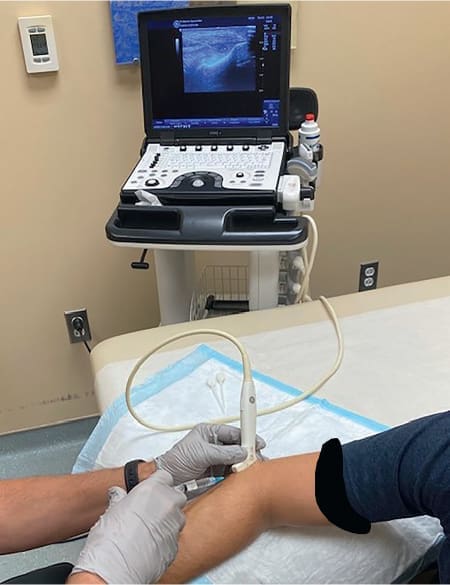
I use an “in-plane” approach for the ultrasound guidance. This means the needle is inserted along the long axis of the ultrasound transducer. This technique is paramount because it allows me to visualize the entire length of the needle, from its entry point through the skin to its very tip. Seeing the tip at all times is the golden rule of safe ultrasound-guided procedures.
Here is the sequence of events, as seen on the ultrasound screen and from my perspective as the operator:
- Needle Entry: After the vapor coolant spray, I introduce the fenestration needle through the anesthetized skin wheal. I watch on the ultrasound monitor as the needle, a bright, hyperechoic line, advances through the subcutaneous fat.
- Targeting the Lesion: I carefully guide the needle tip directly to the edge of the hypoechoic, diseased area within the ECRB tendon that I mapped out earlier.
- Fenestration Passes: Now, the fenestration begins. I advance the needle through the area of tendinopathy, then partially withdraw it, re-angle slightly, and advance again. I repeat this motion, fanning the needle up and down (superficial to deep) and side to side (medial to lateral) to ensure I treat the entire three-dimensional volume of diseased tissue.
- How many passes? The literature and clinical experience suggest anywhere from 15 to 50 passes, depending on lesion size. I don’t just count passes, though. I rely on tactile feedback. As the needle moves through the abnormal tendon, it feels gritty and resistant. As I continue the fenestration, the tissue begins to feel softer, indicating that the fibrotic adhesions are breaking down. When the entire treated area feels uniformly soft to the needle tip, I know the mechanical disruption phase is complete.
- Multi-Planar Confirmation: After treating the tendon in the long axis, I often turn the ultrasound transducer 90 degrees to view the tendon in its short axis (cross-section). This lets me confirm that my fenestration covers the full medial-to-lateral extent of the pathology. If I see an untreated area, I can redirect the needle to cover it.
The entire fenestration process for a tennis elbow typically takes just a few minutes, but it requires intense focus as I correlate what I see on the screen with what I feel through the needle.
Understanding Plantar Fasciitis- Video
Enhancing Healing: The Synergy of Fenestration and Regenerative Injections
While needle fenestration is a powerful standalone procedure, I have found in my clinical practice that its effects can be significantly amplified by combining it with a regenerative injection therapy. The fenestration creates the ideal biological environment—a fresh injury site with disrupted scar tissue and an influx of blood. Following this up with an injection of a substance that further promotes healing creates a powerful one-two punch.
This is where the principles of Prolotherapy and Orthobiologics come into play.
Prolotherapy: Fueling the Fire of Regeneration
Prolotherapy (short for “proliferative therapy”) is a regenerative injection technique that involves injecting a mild irritant solution into damaged connective tissues to stimulate a healing response. The most commonly used and extensively studied agent is dextrose (a form of sugar).
When a hypertonic (highly concentrated) dextrose solution—typically ranging from 12.5% to 50%—is injected into the tissue, it creates a localized osmotic shock. This causes cells to lose water, triggering a temporary, controlled cellular stress. This stress, in turn, signals the body to mount an inflammatory and proliferative response, much like the one initiated by the fenestration itself.
Why combine fenestration with dextrose prolotherapy?
- Synergistic Stimulation: The dextrose acts as a powerful chemical stimulant for the release of local growth factors, augmenting the growth factors already released from the bleeding caused by fenestration. It’s like adding fuel to the fire we just started.
- Nutrient Supply: Dextrose is the primary fuel for cellular activity. Injecting it directly into the healing site provides an immediate energy source for the newly recruited fibroblasts and tenocytes, helping them perform the metabolically demanding task of synthesizing new collagen.
- Enhanced Healing Cascade: Studies have shown that dextrose can directly stimulate the production of key growth factors like PDGF, TGF-β, and EGF, further driving the proliferative phase of healing.
In the video demonstration from the transcript, after completing the needle fenestration of the tennis elbow, you see the final step: injecting the prolotherapy solution. In that case, I used a 25% dextrose solution. The fenestration has tilled the soil, and the prolotherapy acts as the fertilizer, providing the biochemical signals and energy needed for robust tissue growth.
Platelet-Rich Plasma (PRP): Concentrated Healing Power
Another powerful partner for needle fenestration is Platelet-Rich Plasma (PRP). PRP is an orthobiologic, meaning it is derived from the patient’s own body. The procedure involves:
- A simple blood draw from the patient’s arm.
- The blood is placed in a centrifuge, which spins at high speed to separate it into its components: red blood cells, platelet-poor plasma, and a concentrated layer of platelets and growth factors—the PRP.
- This golden-hued PRP is then carefully drawn up and injected into the target tissue.
When PRP is injected into the site prepared by needle fenestration, it delivers a supraphysiological concentration of growth factors—5 to 10 times greater than what is found in circulating blood. This provides an incredibly potent stimulus for tissue regeneration.
The choice between Prolotherapy and PRP depends on several factors, including the severity and chronicity of the tendinopathy, the patient’s overall health, and financial considerations (PRP is generally more expensive). Often, I start with dextrose prolotherapy as it is highly effective and cost-efficient. For more severe or recalcitrant cases, PRP may offer a more powerful regenerative punch.
Regardless of the choice, the underlying principle is the same: use fenestration to create the opportunity for healing, and use a regenerative injectate to maximize that opportunity.
The Role of Chiropractic Care and Rehabilitation in Tendon Healing
Treating the tendon with a needle is only one part of the equation. A truly successful outcome requires a holistic approach that addresses the biomechanical and functional factors that led to the tendon overload in the first place. This is where my background as a Doctor of Chiropractic becomes indispensable in our integrative model.
Why did the patient develop tennis elbow? It’s rarely just a random event. It’s often the result of cumulative micro-trauma stemming from faulty biomechanics. This could be due to:
- Joint Restrictions: A lack of proper mobility in the wrist, elbow, shoulder, or even the cervical and thoracic spine can alter the upper-limb kinetic chain. This forces certain muscles and tendons, like the wrist extensors, to work harder and in a mechanically disadvantaged way, leading to overload and injury.
- Muscle Imbalances: Weakness in the shoulder girdle muscles (like the rotator cuff and scapular stabilizers) can lead to overuse of the smaller forearm muscles for stabilization and movement.
- Poor Ergonomics: Repetitive tasks at work or in sports performed with improper form can place excessive strain on the common extensor tendon.
As part of a comprehensive treatment plan, my role extends far beyond the injection suite.
Chiropractic Manipulative Therapy (CMT)
I will assess the entire kinetic chain for joint restrictions. Using specific chiropractic adjustments, I can restore normal motion to dysfunctional joints in the wrist, elbow, shoulder, and spine. For example, improving the mobility of the carpal bones in the wrist or the radiocapitellar joint in the elbow can immediately reduce the strain on the extensor tendons. Correcting thoracic spine stiffness can improve scapular mechanics, which in turn unloads the entire arm. This addresses the root biomechanical cause of the tendon overload.
Myofascial Release and Soft Tissue Work
Tight, fibrotic muscles and fascia in the forearm often accompany chronic tendinopathy. I utilize techniques like Active Release Technique (ART) or Graston Technique to break down these adhesions, improve tissue extensibility, and restore normal muscle function. This complements the work done by the fenestration at the tendon origin.
A Structured Rehabilitation Program
The period following a fenestration procedure is critical. The newly forming collagen is fragile and needs guidance to mature into strong, organized tissue. This is achieved through a carefully structured and progressive rehabilitation program.
- Initial Rest and Protection (First few days to a week): Immediately after the procedure, the area needs relative rest to allow the initial inflammatory and proliferative phases to begin without disruption. A counterforce brace may be recommended.
- Gentle Range of Motion (Phase 1): We soon introduce gentle, pain-free range-of-motion exercises to prevent stiffness and encourage fluid movement of the new tissue.
- Isometric Loading (Phase 2): Once pain allows, we introduce isometric exercises (contracting the muscle without moving the joint). This provides an early mechanical signal to the healing tendon without placing excessive strain on it.
- Eccentric Loading (Phase 3): This is arguably the most important phase of tendon rehab. Eccentric exercise involves lengthening a muscle while it is under tension (e.g., slowly lowering a weight). Research has shown that eccentric loading is a powerful stimulus for collagen production and remodeling in tendinopathy. It helps to align the new collagen fibers along the lines of stress, creating a stronger, more resilient tendon.
- Concentric and Functional Strengthening (Phase 4): Finally, we progress to traditional concentric (shortening) strengthening and exercises that mimic the patient’s specific work or sport-related activities, ensuring a safe and complete return to function.
This combination of restarting the biology with fenestration and correcting the biomechanics with chiropractic care and rehabilitation is the key to long-term success. One without the other is an incomplete treatment.
Clinical Observations and Concluding Thoughts
I am Dr. Alex Jimenez, and my journey across multiple healthcare disciplines has reinforced one core belief: the human body has a profound, innate capacity to heal itself. Our role as clinicians is often not to suppress symptoms with powerful drugs, but to identify and remove the barriers to healing and to provide the specific stimuli needed to awaken this capacity.
Needle fenestration, especially when integrated into a comprehensive treatment paradigm, perfectly embodies this philosophy. It is not a passive treatment. It is an active process that partners with the body’s own physiology. We are not just treating a “tennis elbow”; we are treating a person with a complex biomechanical and physiological issue. We address the dysfunctional tendon tissue directly with fenestration and prolotherapy, restore proper joint mechanics with chiropractic adjustments, and rebuild resilience and function through targeted rehabilitation. Dr. Maria Cardenas performs all of this under safe, collaborative medical oversight, ensuring the highest standard of care.
Through my clinical observations at PushAsRx and my professional interactions documented on LinkedIn, I have seen this approach succeed where others have failed. I have witnessed patients who were told their only remaining option was surgery find complete and lasting relief, returning to the activities they love. This is the power of evidence-based, integrative medicine. It takes the reader—and the patient—on a journey from chronic pain and dysfunction to restored health and vitality by working with the body, not against it.
References
- McShane, J. M., Nazarian, L. N., & Harwood, M. I. (2006). Sonographically guided percutaneous needle tenotomy for treatment of common extensor tendinosis in the elbow. Journal of Ultrasound in Medicine, 25(10), 1281–1289. https://doi.org/10.7863/jum.2006.25.10.1281
- Finnoff, J. T., Fowler, S. P., & Lai, J. K. (2011). Treatment of chronic tendinopathy with ultrasound-guided needle fenestration and a platelet-rich plasma injectate. PM&R, 3(10), 900–911. https://doi.org/10.1016/j.pmrj.2011.05.015
- Rabago, D., Best, T. M., Zgierska, A. E., Zeisig, E., Ryan, M., & Crane, D. (2009). A systematic review of prolotherapy for chronic musculoskeletal pain. Clinical Journal of Sport Medicine, 19(4), 325–337. https://doi.org/10.1097/JSM.0b013e3181a32368
- Krey, D., Borchers, J., & McCamey, K. (2015). Tendon needling for treatment of tendinopathy: A systematic review. The Physician and Sportsmedicine, 43(1), 80–86. https://doi.org/10.1080/00913847.2015.996408
- Cook, J. L., & Purdam, C. R. (2009). Is tendon pathology a continuum? A pathology model to explain the clinical presentation of load-induced tendinopathy. British Journal of Sports Medicine, 43(6), 409–416. https://doi.org/10.1136/bjsm.2008.051193
SEO Tags: Needle Fenestration, Tendinopathy, Tennis Elbow, Dr. Alex Jimenez, Integrative Medicine, Chiropractic Care, Prolotherapy, Ultrasound-Guided Injection, Regenerative Medicine, El Paso TX, Chronic Tendon Pain, Dr. Maria Cardenas, Tendinosis, ECRB, Lateral Epicondylopathy, Collagen, Growth Factors, PRP, Platelet-Rich Plasma, Rehabilitation, Eccentric Loading, Functional Medicine, Injury Medical Clinic, Musculoskeletal Pain, Non-surgical Treatment, Tendon Healing
Post Disclaimer *
General Disclaimer, Licenses and Board Certifications *
Professional Scope of Practice *
The information herein on "Regenerative Orthopedics and Recovery from Chronic Tendinopathy" is not intended to replace a one-on-one relationship with a qualified health care professional or licensed physician and is not medical advice. We encourage you to make healthcare decisions based on your research and partnership with a qualified healthcare professional.
Blog Information & Scope Discussions
Welcome to El Paso's Premier Wellness and Injury Care Clinic & Wellness Blog, where Dr. Alex Jimenez, DC, FNP-C, a Multi-State board-certified Family Practice Nurse Practitioner (FNP-BC) and Chiropractor (DC), presents insights on how our multidisciplinary team is dedicated to holistic healing and personalized care. Our practice aligns with evidence-based treatment protocols inspired by integrative medicine principles, similar to those on this site and on our family practice-based chiromed.com site, focusing on naturally restoring health for patients of all ages.
Our areas of multidisciplinary practice include Wellness & Nutrition, Chronic Pain, Personal Injury, Auto Accident Care, Work Injuries, Back Injury, Low Back Pain, Neck Pain, Migraine Headaches, Sports Injuries, Severe Sciatica, Scoliosis, Complex Herniated Discs, Fibromyalgia, Chronic Pain, Complex Injuries, Stress Management, Functional Medicine Treatments, and in-scope care protocols.
Our information scope is multidisciplinary, focusing on musculoskeletal and physical medicine; wellness; contributing etiological viscerosomatic disturbances within clinical presentations; associated somato-visceral reflex clinical dynamics; subluxation complexes; sensitive health issues; and functional medicine articles, topics, and discussions.
We provide and present clinical collaboration with specialists from various disciplines. Each specialist follows their professional scope of practice and licensure jurisdiction. We use functional health & wellness protocols to treat and support care for musculoskeletal injuries or disorders.
Our videos, posts, topics, and insights address clinical matters and issues that directly or indirectly relate to our clinical scope of practice.
Our office has made a reasonable effort to provide supportive citations and has identified relevant research studies that support our posts. We provide copies of supporting research studies upon request to regulatory boards and the public.
For further discussion on how this information relates to specific care plans or treatment protocols, please ask Dr. Alex Jimenez, DC, APRN, FNP-BC, or contact us at 915-850-0900.
We are here to help you and your family.
Blessings
Dr. Alex Jimenez DC, MSACP, APRN, FNP-BC*, CCST, IFMCP, CFMP, ATN
Email: [email protected]
Multidisciplinary Licensing & Board Certifications:
Licensed as a Doctor of Chiropractic (DC) in Texas & New Mexico*
Chiropractic Licenses:
Texas DC License #: TX5807, Verified: TX5807
New Mexico DC License #: NM-DC2182, Verified: NM-DC2182
Nurse Practitioner Licenses:
Texas APRN License #: 1191402, Verified: 1191402 *
New Mexico CNP License #: 90560, Verified 90560
Florida APRN License #: 11043890, Verified: APRN11043890 *
Colorado License #: C-APN.0105610-C-NP, Verified: C-APN.0105610-C-NP
New York License #: N25929, Verified N25929
Georgia APRN License #: GAA-NP005701
Multi-State Advanced Practice Registered Nurse (APRN*) Texas & Multi-States
Multi-state Compact APRN License by Endorsement (43 States)
Compact Status: Multi-State License: Authorized to Practice in 43 States*
Nursing Licensure Compact: Updated Here
DEA Registration: (Drug Enforcement Agency Registered)
All medical (MDs) and family practice providers (FNP-APRN) are registered and licensed to offer various levels of medication.
Verify Providers Here
License Verification Link: Nursys License Verifier
* Prescriptive Authority Authorized (DEA Registered Providers). Call if Required
Board Certification:
ANCC FNP-BC: Board Certified Nurse Practitioner*
Education:
Graduate with Honors: ICHS: MSN-FNP (Family Nurse Practitioner Program)
Degree Granted. Master's in Family Practice, MSN Diploma (Cum Laude)
Dr. Alex Jimenez, DC, APRN, FNP-BC*, CFMP, IFMCP, ATN, CCST
(Board Certified: Family Practice Nurse Practitioner—Multistate)*
(Licensed Nurse Practitioner & Chiropractor - Multistate)*
Clinical Director
DC & FNP License (Review Above)
Digital Business Card
NPI: 1205907805
Dr. Maria Cardenas, MD
(Board Certified: Internal Medicine)
(Licensed Medical Doctor)
Medical Director, Clinical Director & Collaborative Physician
NPI # 1164426748
MD License #: J2933
Licenses and Board Certifications:
MD: Medical Doctor
DC: Doctor of Chiropractic
APRNP: Advanced Practice Registered Nurse
FNP-BC: Family Practice Specialization (Multi-State Board Certified)
FNP-BC: Family Practice Across Life Span (Neonatal to Geriatrics)
RN: Registered Nurse (Multi-State Compact License)
CFMP: Certified Functional Medicine Provider
MSN-FNP: Master of Science in Family Practice Medicine
MSACP: Master of Science in Advanced Clinical Practice
IFMCP: Institute of Functional Medicine
CCST: Certified Chiropractic Spinal Trauma
ATN: Advanced Translational Neutrogenomics
Family with Primary Care Focus (Family Nurse Practitioner or FNP)
- The Family Nurse Practitioner (FNP) promotes, maintains, and restores health for individuals and families across the lifespan. FNPs also identify health risks, promote wellness, and diagnose and manage acute and chronic illness.
- The FNP focuses on comprehensive primary care, promoting healthy lifestyles for patients across the lifespan in settings such as private practice, physician offices, and community health centers.
Memberships & Associations:
TCA: Texas Chiropractic Association: Member ID: 104311
TNA: Texas Nurse Association: Member ID: 06458222
TNP: Texas Nurse Practitioner Association ID: 2025091511
AANP: American Association of Nurse Practitioners: Member ID: 2198960
ANA: American Nurses Association: Member ID: 06458222 (District TX01)
| Primary Taxonomy | Selected Taxonomy | State | License Number |
|---|---|---|---|
| No | 111N00000X - Chiropractor | NM | DC2182 |
| Yes | 111N00000X - Chiropractor | TX | DC5807 |
| Yes | 363LF0000X - Nurse Practitioner - Family | TX | 1191402 |
| Yes | 363LF0000X - Nurse Practitioner - Family | FL | 11043890 |
| Yes | 363LF0000X - Nurse Practitioner - Family | CO | C-APN.0105610-C-NP |
| Yes | 363LF0000X - Nurse Practitioner - Family | NY | N25929 |
| Yes | 363LF0000X - Nurse Practitioner - Family | NM |
90560 |
| Yes | 363LF0000X - Nurse Practitioner - Family | GA | GAA-NP005701 |
Dr. Alex Jimenez, DC, APRN, FNP-BC*, CFMP, IFMCP, ATN, CCST
(Board Certified: Family Practice Nurse Practitioner—Multistate)*
(Primary Care Across Lifespan—Neonatal / Pediatric / Adult / Geriatrics)
(Licensed Nurse Practitioner & Chiropractor - Multistate)*
Clinical Director
Digital Business Card
NPI: 1205907805
Dr. Maria Cardenas, MD
(Board Certified: Internal Medicine)*
(Licensed Medical Doctor)*
Medical Director, Clinical Director & Collaborative Physician
NPI # 1164426748
MD License #: J2933
📆 Schedule Appointment: Schedule 24/7 (Click Here)